Car Dent Repair Manchester: Experts in pulling out dents
Get a free quote. Call or text us 24/7 for a fast response.
Located 10 minutes away from Manchester City Centre.
Should a car dent be pulled out or filled?
In many cases it actually takes longer to pull a dent properly than it does to fill it and paint it. This is why some bodyshops go straight for sanding, filler and paint, because it is often quicker and less demanding on the technician.
Even so, pulling the dent out carefully and beating the panel back into its original shape without paint or body filler is always the preferable repair. It keeps the car closer to its factory condition and avoids unnecessary refinishing work whilst also recovering the strength of the metal thus making it safer for the people inside the car. Most dents can be pulled out with the right equipment, but restoring the panel so it looks untouched requires skill and experience rather than relying on filler.
This is why you should come to us as a professional body shop in Manchester (bodyshopmanchester.co.uk).
Professional Assessment: Should dents always be repaired?
Not every dent should be repaired. Some dents are too deep, too sharp or have stretched the metal beyond what can be safely recovered. If the metal has moved too far, the correct method is to replace the panel, especially on modern vehicles where manufacturers have strict guidelines. We always assess the depth, the movement of the metal, the condition of the paint and whether the crash structure behind the panel has been affected.
If repairing the panel will not return it to factory condition, replacement is the right decision. This is explained in more detail in our blog on when a panel should be repaired or replaced, which you can read here: Should a badly damaged quarter panel be replaced or repaired?
Proper Tools for Dent Repairs
Our team at Bodyshop Manchester is equipped with the following tools to professionally remove dents:
- A glue gun with glue tabs which are used when the paint is still intact so the dent can be lifted without sanding.
- A stud welder which attaches small metal pins to the panel when the paint is cracked or when the dent needs more pulling strength.
- A slide hammer or pulling bar that grips the glue tab or the welded pin to pull the metal outward.
- A body hammer and dolly which are used to tap down high spots and help the panel settle back to its original shape.
The Process: How to pull out a dent and recover the original shape
There are two main scenarios when repairing a dent. The method depends entirely on whether the paint has survived the impact.
1) When the dent is smaller and the paint has not cracked
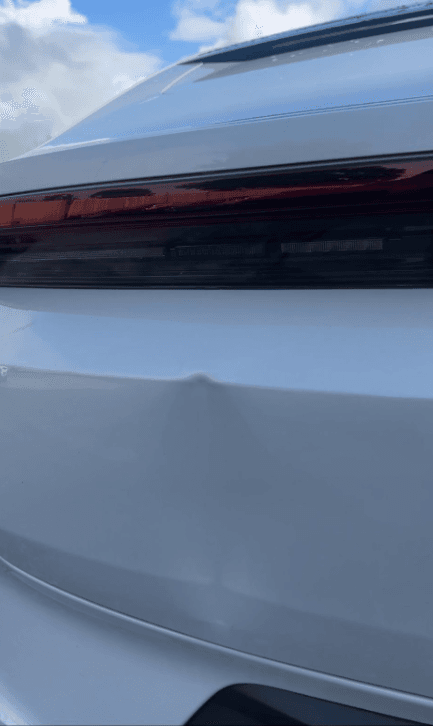
If the paint is still intact, the safest option is to lift the dent using glue tabs. A glue gun is used to place a tab in the lowest point of the dent, and a small lifter or pulling bar is used to raise the metal slowly. As the panel moves, high spots are tapped down and the shape is checked under a reflection light. This method avoids sanding or welding and keeps the original paint in place.
2) When the dent is large and the paint is cracked or the panel is damaged
A big dent that has cracked the paint or stretched the metal needs a different approach. Metal pins are welded to the panel so a slide hammer or pulling bar has enough grip to lift the metal properly. After the first pull, we mark the surface with engineer's blue which shows the highs and lows that normal light cannot reveal. The panel is then sanded lightly to remove the blue from the high spots, leaving the low areas visible.
The dent is worked in stages. A little is pulled, the high spots are tapped down, the surface is marked again with engineer's blue and sanded again. This cycle repeats until the colour sands away evenly across the panel. That is the sign that the metal is returning to the same level. A common beginner's mistake is to keep pulling without tapping. That never brings the panel back to its original contour. Proper car body repair Manchester is a steady balance of lifting the low areas and beating down the high ones until the shape is right.
Quality Control: How do we know if the panel shape is right?
You cannot judge the shape of a repaired panel by eye alone. A panel may look smooth in daylight but show distortion under the correct lighting. This is why at Bodyshop Manchester we use reflection lamps and line boards. When the light hits the panel, any remaining waves, dips or high spots become clear. Bent lines show a low spot, raised lines show a high spot, and straight lines mean the surface is true.
The panel is checked from different angles and distances. If anything shows up under the lamp, even slightly, the metal is worked again until it disappears. Only when the reflections run straight and clean can you say the panel has returned to its original shape.
What happens after we have fixed the shape of the panel?
When the paint has not cracked
If the dent was repaired using glue tabs and the paint stayed intact, the job is almost complete once the shape is correct. The panel is cleaned, lightly polished and checked again under reflection lighting. Because the original paint is untouched, no filler or painting is needed. This is the ideal outcome.
When the paint has cracked or the panel has been sanded or welded
If the repair required sanding, welding or any metalwork that broke the paint, the panel must be refinished. Once the shape is correct, the surface is keyed, primed and prepared for paint. The colour is matched precisely and blended into the surrounding panels so the repair is invisible. Bare metal must always be sealed, so painting is not optional in this scenario for any accident repair.
How long does a dent repair take at Bodyshop Manchester?
The timing depends on the size of the dent and whether the paint needs to be redone. A smaller dent with intact paint can often be repaired within a few hours because the metalwork is the only stage. A larger dent that required sanding or welding takes longer, usually between two and five days. The panel needs priming, painting and curing time before it can be washed or polished. Some colours, especially pearlescent and three stage paints, take longer because they require multiple layers to match correctly.
Need help with a dent on your car?
If your vehicle has a dent, whether small or severe, we can repair it properly using the right tools and techniques. We deal with everything from light parking dents to heavy impact damage, and we always aim for the best possible finish. You can get in touch with us, send photos for an estimate or book your repair through our website at bodyshopmanchester.co.uk.